

Over five months spanning late 2025 and early 2026, a Veterans Affairs hospital in Georgia kept losing its main operating room. Staff at the VA Augusta Health Care System told federal inspectors it closed four times between October 2025 and February 2026, once for 27 days, because surgical kits arrived incomplete, supplies had expired and restocking couldn’t be trusted.
The VA Office of Inspector General report, published in September, also found that the health system had awarded a $3.2 million contract for an automated inventory platform that was never fully installed. A former supply chief disabled it in 2023, and inspectors found some of its equipment abandoned in a warehouse.
Augusta is a local failure with a long federal backstory. The Government Accountability Office added VA acquisition management to its High-Risk List in 2019, partly because of supply chain problems that predated the pandemic, and in 2021 urged the department to build a comprehensive supply chain strategy that tied its scattered modernization efforts together. As of February 2025, VA was still working on it.
Washington’s conversation about AI in health care tends to revolve around clinical tools, diagnostic algorithms and FDA clearances. Augusta is a reminder that a missing tray of instruments can cancel a surgery as surely as a misread scan can derail a diagnosis, and that the systems moving supplies through a hospital deserve the same scrutiny.
The price of stitching systems together by hand
The problem reaches well beyond the VA. A single medical supply passes through distributors, pharmacies, clinics and laboratories before it reaches a patient, and each of them runs on its own software, spreadsheets, email threads and phone calls.
The data needed to keep shelves stocked usually exists, but it sits in separate places, and staff end up reconciling it manually. Shortages in medical devices and drugs now add an average of $3.5 million a year to the cost of delivering care for a medium-size health system, according to Premier survey data. On a broader scale, a study in the Annals of Internal Medicine estimated that administration consumed 34.2% of U.S. national health spending in 2017.
What Augusta shows is that buying technology does little when it never fits the way people do their jobs. The harder work is getting every link in the chain to share information and act on it in sync.
Where the oversight debate meets the warehouse
Policymakers on both sides of the Atlantic have settled on human oversight as the principle that should govern high-stakes AI.
The HHS artificial intelligence strategy released in December 2025 requires the department’s divisions to apply minimum risk management practices to high-impact systems, including human oversight, bias mitigation and outcome monitoring. In Europe, Article 14 of the EU AI Act requires high-risk systems to allow effective human oversight, including the power to override them.
What those rules leave open is how oversight should work when an AI system is producing thousands of decisions a day.
Adrián Figueroa has a working answer. An electrical engineer and graduate of the Stanford Graduate School of Business, he launched Routina in 2024, a platform that uses software and AI to help medical product distributors and other healthcare organizations connect information across their systems and reduce manual coordination.
Figueroa argued that reviewing every output by hand defeats the purpose. “With AI as it stands now, the volume of output is more than a human can process,” he said. “Reviewing everything turns the human into the bottleneck, but human judgment is still needed for high-risk or low-confidence decisions.”
Routina’s approach assigns every result a confidence score and a risk score. People review and approve only what comes back as low confidence or high risk, while the system tracks its own performance on the outputs it treats as safe.
Figueroa was firm that the review has to carry weight. “Human oversight has to be real, not a person clicking ‘approve’ all day,” he said. “Specific people own those flagged decisions, they have the authority to override the system, and every override is logged and reviewed.”
He also stressed regular scrutiny of what the system measures and why. “If the input data is biased, AI will apply that bias faster and at scale,” he said. “What AI shouldn’t do is make the final decision.”
A test run in the Caribbean
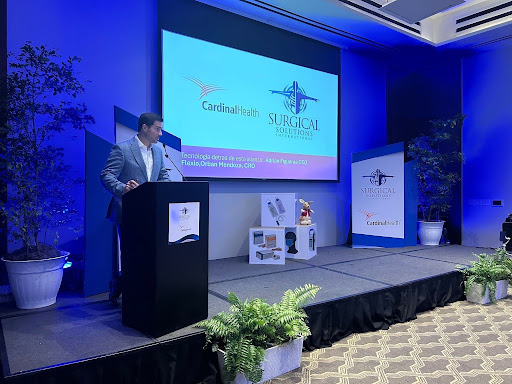
The model is now heading into a live supply chain. Surgical Solutions International, a surgical services and medical products distributor, launched a new line of medical products in the Dominican Republic with Cardinal Health as part of a strategic alliance.
“We will be implementing Routina’s technology at Surgical Solutions to manage all of Cardinal Health’s products and those of future suppliers,” Figueroa explained.
Routina also plans to present itself directly to Cardinal Health “as a solution to manage all of its distributors in the different countries where it operates,” he said.
That would move the experiment from one distributor in Santo Domingo to a multinational network, the kind of sprawling, multi-party supply chain that federal agencies like the VA have spent years trying to bring under control.
Featured image: courtesy of Routina

Disclosure: This article mentions a client of an Espacio portfolio company.