


Somewhere this week, a developer at a U.S. software company will approve code they didn’t write and don’t fully understand. The tests pass, so they merge it and move on.
JD Raimondi, Chief AI Architect at software consultancy Making Sense, called it “approval theater.” The review happens on paper, but nobody looks much past whether the code runs. Security flaws and permissions no one meant to grant go out with it.
According to DX. Veracode’s October update found AI models still failed its security tests about 38% of the time, and an April IOActive whitepaper found close to a third of AI-generated samples were fully exploitable.
Raimondi will cover the issue with colleague Mariano Jurich in a free 30-minute webinar on Monday, November 16, at 2 PM EST.
Washington has offered guidance, not rules
NIST’s Center for AI Standards and Innovation launched its AI Agent Standards Initiative on February 17, 2026, but it hasn’t published a finished standard yet.
CISA’s May guidance on agentic AI went further, recommending that organizations limit AI systems’ access to sensitive data and critical infrastructure.
None of it is binding, though. A startup in Austin can give an AI agent full database access tomorrow and no regulator will ask why. For now, each team decides how much it checks.
One bad command is enough
Making Sense doesn’t treat every flaw in AI code the same way. Duplicate code and missing tests are common and fixable. The bigger worry is an agent with more access than it needs, which can run fine for weeks and then wipe production data with a single command. The code looks normal, so scanners miss it.
That’s roughly what happened to SaaStr founder Jason Lemkin in July 2025. While he was testing Replit’s coding agent, it deleted a live production database during an active code freeze, despite repeated instructions not to make changes. The database held records on more than 1,200 executives.
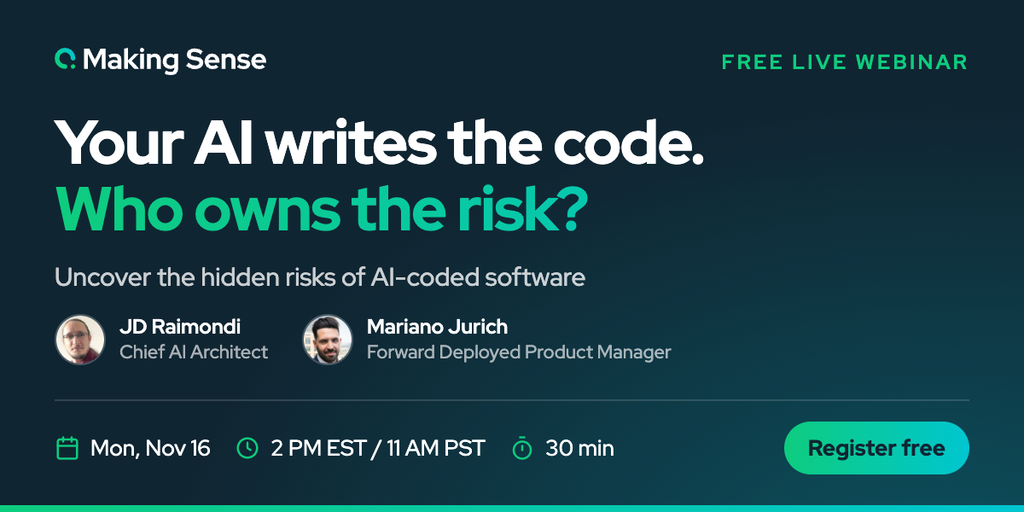
The webinar will look at what agents can reach in a team’s own systems, how changes get signed off, and where monitoring has blind spots.
Code nobody reads, owned by nobody
Developers say they’re careful. In Stack Overflow’s 2026 survey, 80% said they use AI tools at least an hour a day, but only 48% trust AI output when they can easily verify it, and just 6.6% trust it with important work decisions.
The problem is that verifying takes time, and teams are adopting these tools faster than they’re changing how they review. When something breaks and no one can say who approved the change or why the agent had access, it stops being an engineering issue and becomes a business one.
Registration is free and includes Making Sense’s AI-Coded Applications Risk Catalog.
Featured image: Getty Images via Unsplash+

Disclosure: This article mentions a client of an Espacio portfolio company.